
By Dr. Marco V. Benavides Sánchez – Medmultilingua.com /
Abstract:
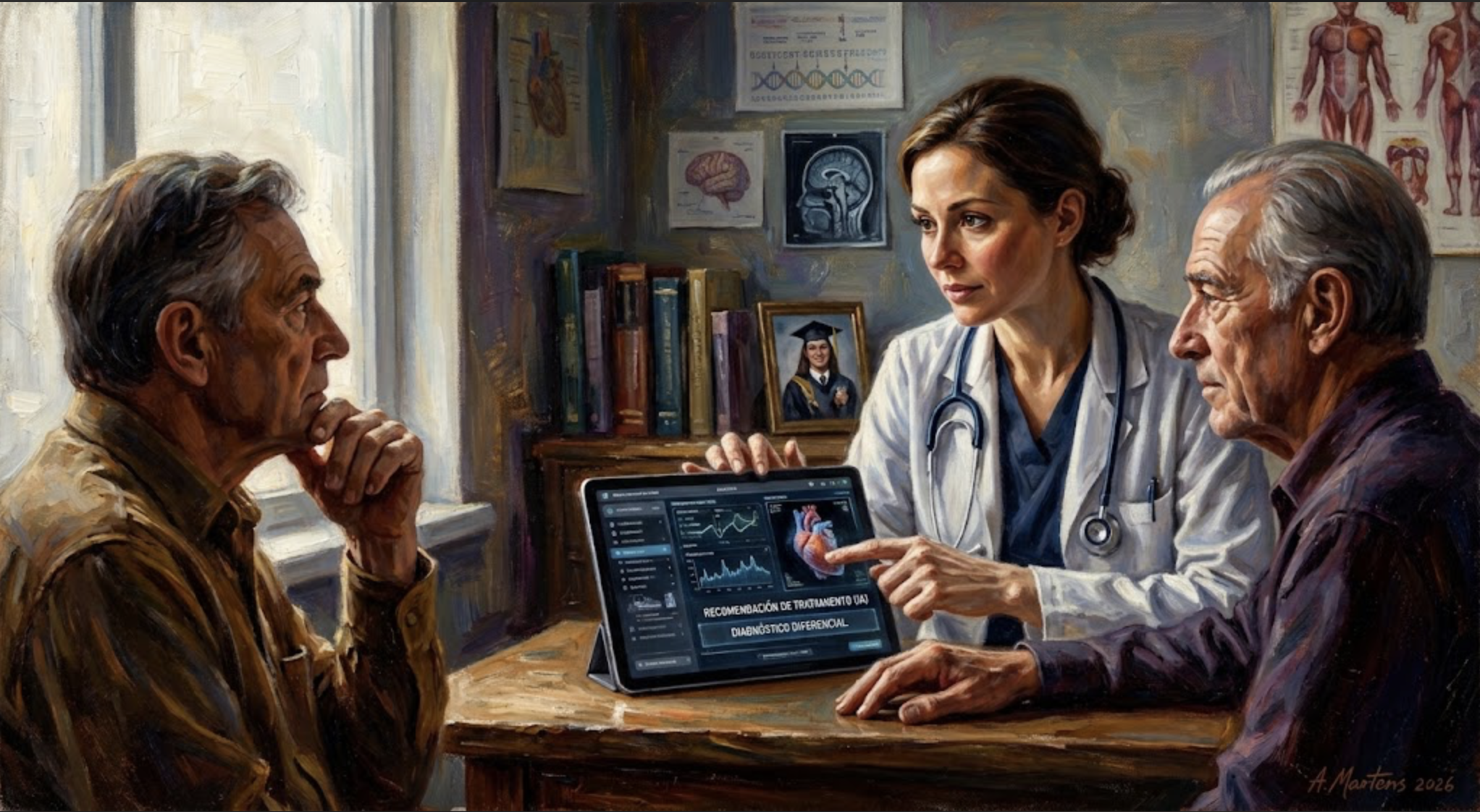
October 2026 has been one of the most intense months for artificial intelligence applied to medicine. A Microsoft system that simulates a panel of physicians outperformed general practitioners in complex clinical cases; the first large-scale study on the real-world use of AI by nearly a million clinicians revealed that doctors consult it more for treatment decisions than for diagnosis; and new models have succeeded in detecting hidden diseases in CT scans, predicting cancer survival based on a photograph of a patient’s face, and identifying the gene responsible for hereditary retinal diseases. Meanwhile, the FDA is moving toward specific regulation for generative AI, and the pharmaceutical industry continues to invest billions in drugs designed by algorithms—drugs that have yet to receive full approval. This article reviews these developments, alongside evidence that warrants caution, and poses a central question: Are we prepared to oversee a technology that is already learning faster than we are?
Keywords: Artificial intelligence; medicine; clinical diagnosis; MAI-DxO; OpenEvidence; computed tomography (CT); ophthalmology; FDA regulation; drug discovery; automation bias.
There are months when science advances slowly and quietly. October 2026 was not one of them.
In just a few weeks, journals such as Science, JAMA, Nature Medicine, and The Lancet Digital Health published studies that, taken together, paint a clear picture of the current state of medicine: artificial intelligence is no longer a promise confined to laboratories, but an everyday presence in clinical practice. Yet, they also reveal something more unsettling. Paradoxically, the more powerful a tool becomes, the more important the hand that wields it.
A panel of doctors that fits on a server
On October 22, a Microsoft team published results in Science regarding MAI-DxO, a system that coordinates multiple AI agents acting like a panel of specialists discussing a case. [medicaleconomics.com]
The figures are striking. When faced with complex clinical cases from the New England Journal of Medicine, the system reached the correct diagnosis 83.2% of the time, compared to 36.1% for general practitioners who had access to search engines and reference materials. For routine emergency department admissions, the figures were 80.3% versus 46.8%, and the system frequently recommended less costly diagnostic tests. [medicaleconomics.com]
However, the authors themselves were quite cautious: this was a controlled, text-only test, and these comparisons do not demonstrate superiority over human specialists, multidisciplinary teams, or actual clinical practice. [medicalxpress.com]
The distinction matters: a laboratory or diagnostic test result is not a patient.
What doctors are actually asking AI
While headlines spoke of machines that make diagnoses, a study published on October 15 in JAMA revealed something different. Researchers from Harvard Medical School and Brigham and Women’s Hospital analyzed how 950,000 physicians, physician assistants, and nurse practitioners in the United States used OpenEvidence, an AI-based clinical information platform. [hms.harvard.edu]
Between January 2024 and June 2026, the number of monthly active users grew from 355 to 703,265. More than half of the queries related to clinical decision-making, while diagnosis accounted for only 13.9%. [hms.harvard.edu] Physicians asked more than twice as many questions about treatment as they did about diagnosis—and frequently did so regarding areas outside their own specialty. [ibm.com]
In other words, AI is not replacing the “clinical eye.” Instead, it is becoming the colleague one might consult in the hallway—now available at any hour.
What a CT scan leaves unsaid
At Penn Medicine, a model called Percival—trained on hundreds of thousands of CT scans—demonstrated that any given scan contains far more information than what prompted the initial request. As detailed in NPJ Digital Medicine, the system detected signs of atrial fibrillation and chronic kidney disease, and identified conditions such as pancreatic cancer, cirrhosis, and bacterial pneumonia with greater reliability than other models. [pennmedicine.org]
For those of us who have spent years in the operating room, this is a compelling concept: an image ordered to rule out appendicitis might actually be alerting us to something far more serious.
A face that speaks to survival
Perhaps the most striking finding of the month came from Mass General Brigham. Researchers there developed a model called FAHR-Face—trained on more than 40 million facial images—that is capable of estimating biological age and predicting survival outcomes for cancer patients… based on a single photograph. The study was published on October 19 in The Lancet Digital Health. [beckershospitalreview.com]
Individuals placed by the model in the highest-risk category showed a mortality rate more than three times higher than those in the lowest-risk category. [worldhealth.ai]
This finding confirms something that clinicians have sensed for centuries: a patient’s face tells a story. We call these “facies” (e.g., Hippocratic, Cushingoid, Parkinsonian, etc.). The difference now is that an algorithm can read this story with numerical precision—raising ethical questions to which we do not yet have answers.
The gene hidden behind the retina
In ophthalmology, an international team presented the “Retina4IRD” system in Nature Medicine. It analyzes fundus photographs, optical coherence tomography (OCT) scans, and basic clinical data to predict the genetic cause of hereditary retinal dystrophies—potentially avoiding the need for costly genetic testing. [scienceinpoland.pl]
Physicians using the system identified the responsible gene among their top five most likely diagnoses in 88.5% of cases, compared to 67.3% for specialists working without such support. [scienceinpoland.pl]
In this instance, AI does not replace the specialist; it enhances their performance.
The flip side: when the machine gets it wrong
Not all evidence points in the same direction. A clinical study published in NEJM AI evaluated physicians trained in AI literacy who were presented with incorrect suggestions from a language model. Their diagnostic accuracy fell to 73.3%, compared to 84.9% for the control group—a drop of 14 percentage points. [ai.nejm.org]
This phenomenon has a name: “automation bias”—the human tendency to trust a machine even when it is wrong. And most concerningly, it affected physicians who had already been trained to avoid such issues.
Another study, conducted in Kenya and published in Nature Medicine, offers an equally valuable lesson. A generative AI tool integrated into the clinical record improved the quality of documentation and treatment planning—and proved safe—but it did not significantly alter short-term patient outcomes: the 14-day therapeutic failure rate was 2.2% versus 2.0%. [birmingham.ac.uk]
Better decisions on paper do not always translate into better patient outcomes.
How do you regulate something that changes every day?
As of September 2026, the FDA has authorized more than 1,600 AI-enabled medical devices in the United States. [fda.gov] The agency is now developing a specific framework for devices based on generative AI, which can produce a virtually limitless range of inputs and responses. The proposal suggests a risk-based approach, taking into account the system’s level of autonomy and the potential severity of harm should it make an error. [ama-assn.org]
On October 16, the American Medical Association submitted its comments, and various healthcare provider organizations reached a consensus: ethical responsibility should lie with the developers, not the physicians. The agency expects to release a draft guidance document in the coming months. [healthcaredive.com]
Drugs designed by algorithms: heavy investment, zero approvals
In the pharmaceutical industry, the enthusiasm persists. AstraZeneca has agreed to pay $40 million upfront to Insitro to use its AI platform to identify new therapeutic targets for liver and heart diseases, with the potential for an additional $1.46 billion tied to future milestones. [pharmaphorum.com]
However, as of August 2026, no drug discovered through AI had received full FDA approval. [clinicaltrialvanguard.com] The most advanced candidate, rentosertib—developed by Insilico Medicine for idiopathic pulmonary fibrosis—improved lung function during an early stage of clinical evaluation. It will now undergo a larger, longer-term study to determine whether these benefits can be confirmed, a necessary step before seeking eventual regulatory approval. [biopharmadive.com]
AI can accelerate discovery. Biology, however, continues to set its own pace.
And what about Latin America?
The study from Kenya offers a glimpse into what might unfold in our own region. In areas where specialists are in short supply, a tool that enhances clinical reasoning and treatment planning holds immense value—even if its benefits are not immediately reflected in the statistics.
Yet, the lesson is clear: technology alone cannot transform a healthcare system. Success requires high-quality data, reliable infrastructure, staff training, and, above all, oversight mechanisms to protect patients.
The remaining question
As of October 2026, we are left with a conclusion that may seem contradictory, though it is not: artificial intelligence has never been more capable—and human judgment has never been more necessary.
Algorithms are already diagnosing, predicting, and making suggestions. What they still cannot do is take responsibility for a decision, nor can they look a patient in the eye to explain it.
Because, ultimately, the question is not whether the machine is right; it is whether we will be able to recognize when it is not.
Sources:
• Medical Economics. “AI system outperforms physicians on diagnostic accuracy in Microsoft study.” https://www.medicaleconomics.com/view/ai-system-outperforms-physicians-on-diagnostic-accuracy-in-microsoft-study
• Medical Xpress. “AI gets more diagnoses right than generalist doctors.” https://medicalxpress.com/news/2026-10-ai-generalist-doctors-medical.html
• Harvard Medical School. “First Large-Scale Study Shows How Doctors Use AI in Medicine.” https://hms.harvard.edu/news/first-large-scale-study-shows-how-doctors-use-ai-medicine
• IBM Think. “Doctors are using AI for more than diagnosis, study finds.” https://www.ibm.com/think/news/doctors-using-ai-more-than-diagnosis-study-finds
• Penn Medicine. “AI model can uncover unseen health issues in CT scans.” https://www.pennmedicine.org/news/ai-model-can-uncover-unseen-health-issues-in-ct-scans
• Becker’s Hospital Review. “Mass General Brigham AI trained on 40M faces predicts cancer survival.” https://www.beckershospitalreview.com/healthcare-information-technology/ai/mass-general-brigham-ai-trained-on-40m-faces-predicts-cancer-survival/
• WorldHealth.AI. “Healthcare AI Intelligence Briefing, October 2026.” https://www.worldhealth.ai/insights
• Science in Poland. “AI helps doctors spot genetic causes of eye disease with greater accuracy.” https://scienceinpoland.pl/en/news/news,114346,ai-helps-doctors-spot-genetic-causes-eye-disease-greater-accuracy.html
- NEJM AI. “Automation Bias in Large Language Model–Assisted Diagnostic Reasoning among Physicians Trained in AI Literacy — A Randomized Clinical Trial.” https://ai.nejm.org/doi/abs/10.1056/AIoa2501001
- University of Birmingham. “AI improved clinical decisions in primary care trial.” https://www.birmingham.ac.uk/news/2026/ai-clinical-support-tool-improved-clinician-decisions-in-real-world-primary-care-trial
•U.S. Food and Drug Administration. “Artificial Intelligence-Enabled Medical Devices.” https://www.fda.gov/medical-devices/digital-health-center-excellence/artificial-intelligence-enabled-medical-devices - American Medical Association. “Oct. 23, 2026: National Advocacy Update.” https://www.ama-assn.org/health-care-advocacy/advocacy-update/oct-23-2026-national-advocacy-update
- Healthcare Dive. “Developers, not doctors, should be held accountable for generative AI medical devices.” https://www.healthcaredive.com/news/developers-not-doctors-held-accountable-generative-ai-medical-devices-fda/833738/
- pharmaphorum. “AI in drug discovery & development: News watch, October 2026.” https://pharmaphorum.com/news/ai-drug-discovery-development-news-watch-october-2026
- Clinical Trial Vanguard. “AI Drug Discovery Has $8.9 Billion in Hype and Zero FDA Approvals.” https://www.clinicaltrialvanguard.com/opinion/ai-drug-discovery-has-8-9-billion-in-hype-and-zero-fda-approvals-when-does-the-bill-come-due/
• BioPharma Dive. “How well are AI-discovered drugs faring in the clinic?” https://www.biopharmadive.com/news/ai-drug-discovery-insilico-recursion-verge/825367/
Recommended hashtags:
AIinMedicine, #DigitalHealth2026, #ClinicalDiagnosis, #MedTech, #Medmultilingua
© Medmultilingua 2026 — Science accessible to everyone, all around the world.
Leave a Reply