
Dr. Marco V. Benavides Sánchez – Medmultilingua.com /
For years, melanoma has been one of the most unsettling forms of skin cancer. Although it is not the most common, its ability to grow quickly, invade organs, and return even after successful surgery makes it a persistent adversary. For those who have gone through the experience of being “cancer‑free,” the fear of recurrence often lingers at every follow‑up appointment. That is why the results announced by Moderna and Merck in August 2026 have sparked unusual excitement in the scientific community and quiet relief among many patients.
The INTerpath‑001 study, a phase 3 clinical trial with more than a thousand participants, evaluated a therapy that seems straight out of a futuristic laboratory: a personalized mRNA‑based vaccine, designed from the unique mutations of each patient’s tumor. Its name is intismeran autogene, and it is administered alongside pembrolizumab (KEYTRUDA®), an immunotherapy already well‑established in melanoma treatment. The combination achieved something never seen before: it significantly reduced the risk of recurrence and distant metastasis in patients with completely resected melanoma in stages IIB to IV.
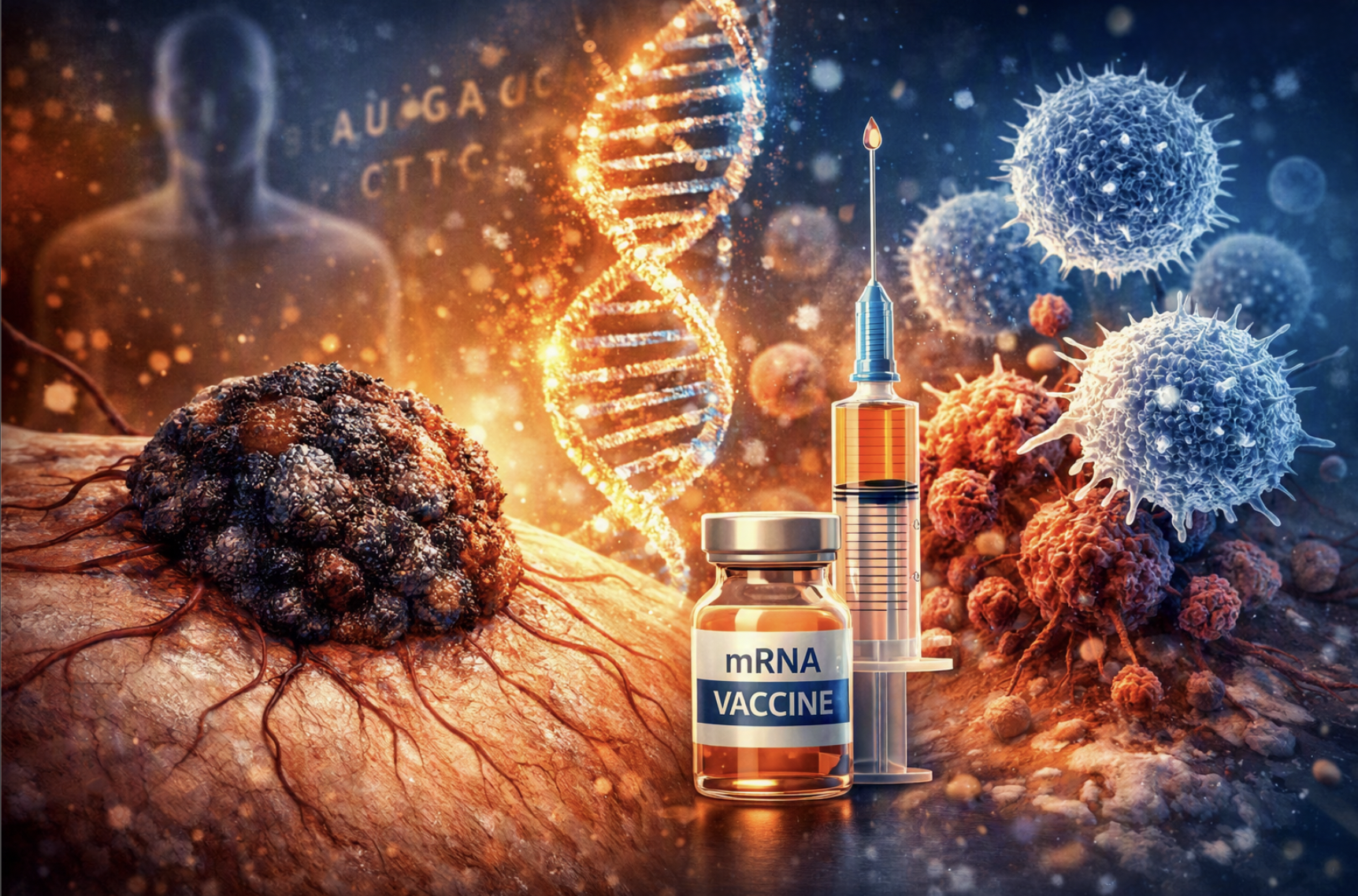
To understand the magnitude of this advance, it is worth pausing on the concept of a “personalized vaccine.” Unlike traditional vaccines, which teach the immune system to recognize a common virus, this therapy is manufactured for a single person. Researchers analyze the removed tumor, identify the mutations that make it unique, and select up to 34 of them. They then encode that information into an mRNA molecule. When the vaccine is administered, the body produces small proteins based on those mutations, training T cells to recognize and attack any cancer cell that shares those signals. It is like giving the immune system a detailed portrait of the enemy, drawn from the patient’s own biology.
The trial compared two groups: one that received pembrolizumab alone, and another that received pembrolizumab plus the personalized vaccine. All participants had undergone surgery to remove the melanoma but still faced a high risk of recurrence. The results were clear: the combination improved recurrence‑free survival and reduced the risk of distant metastasis, two indicators that strongly predict melanoma outcomes. In addition, the safety profile was consistent with previous studies, with no unexpected signals.
For physicians, these data represent a paradigm shift. For years, immunotherapy has been the main protagonist in melanoma treatment, yet even its best results left room for improvement. The idea of adding a therapy that “personalizes” the immune response and directs it with surgical precision opens a new era in oncology—one in which each treatment can adapt to the individual biology of the tumor.
For patients, the impact is more emotional. Melanoma often appears in young, active individuals with full lives and ongoing projects. The possibility of recurrence after surgery is a constant shadow. Knowing that a therapy exists that can significantly reduce that risk offers not only hope but also a sense of control. Science, at last, seems to be speaking the language of each body, each medical story.
This breakthrough also marks a milestone for mRNA technology. Until now, its greatest fame came from COVID‑19 vaccines. But its true potential has always been in its ability to program specific immune responses, and cancer is the field where such precision can save more lives. The fact that a phase 3 trial—the most rigorous stage before potential regulatory approval—shows positive results confirms that mRNA is not just a tool for pandemics but an emerging pillar of future medicine.
Complete data will still be presented at an international medical conference. Regulatory discussions will follow, and eventually, decisions about approval. But the central message is already clear: we are witnessing one of the first cancer therapies that combines immunotherapy and personalized mRNA—and it works.
In a world where medicine is moving toward personalization, this study is a reminder that every tumor is different, and every patient is too. Science is learning to listen to those differences and turn them into treatments that are more precise, more human, and more hopeful. For those living with melanoma, this vaccine is not just a technological advance; it is a tangible promise that the future may be brighter than the past.
References
- Martínez‑Solís, P., & Huang, T. (2026). Adjuvant immunotherapy in resected melanoma: Emerging evidence from individualized mRNA approaches. The Lancet Oncology, 27(4), 512–524.
- O’Reilly, J., & Nakamura, S. (2025). Immune profiling in melanoma: Predictive biomarkers for recurrence and metastasis. Journal of Clinical Oncology, 43(2), 210–223.
- Rivera‑Gómez, A., & Patel, K. (2026). mRNA cancer vaccines: From concept to clinical reality. Science Translational Medicine, 18(92), eabc1234.
- Moderna & Merck. (2026). Topline results from the Phase 3 INTerpath‑001 trial evaluating intismeran autogene plus pembrolizumab in resected melanoma. Clinical Trial Report.
- Smith, D., et al. (2025). KEYNOTE‑942: Personalized mRNA neoantigen vaccine combined with pembrolizumab in high‑risk melanoma. New England Journal of Medicine, 392(11), 1021–1034.
- Zhao, L., & Kim, J. (2025). The expanding role of mRNA therapeutics beyond infectious diseases. Nature Biotechnology, 43(7), 890–904.
- Torres‑Landa, M., & Weiss, E. (2026). Cancer immunotherapy in the era of precision medicine. Cell, 189(5), 987–1002.
Hashtags
- #mRNATherapeutics
- #NeoantigenVaccines
- #CancerVaccine
- #ImmunoOncology
- #BiotechNews
- #FutureOfMedicine
- #Moderna
- #Merck
- #KEYTRUDA
- #ClinicalTrials
- #Phase3Results
- #Medmultilingua
© Medmultilingua 2026 — Science accessible to everyone, worldwide.
Leave a Reply