
Dr. Marco V. Benavides Sánchez – Medmultilingua.com /
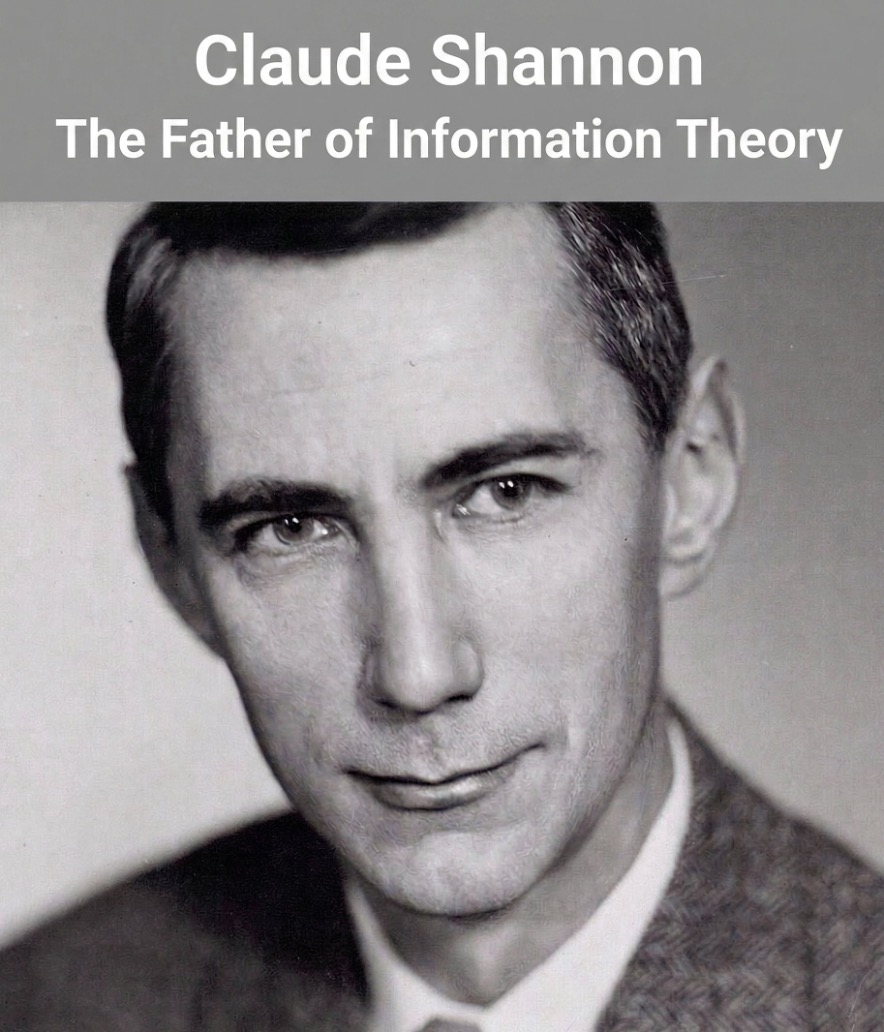
The intellectual history of the 20th century is marked by figures who, through mathematical abstraction, irreversibly transformed everyday life. Among them, Claude Elwood Shannon occupies a unique place. His work not only inaugurated information theory but also established the conceptual foundations of digital computing, modern cryptography, and the early developments of artificial intelligence. In a century dominated by physics and engineering, Shannon introduced a new way of thinking: the idea that information—that intangible entity that permeates languages, machines, and minds—could be measured, quantified, and transmitted with mathematical precision. His legacy constitutes one of the most influential intellectual architectures of technological modernity.
Born in 1916 in Michigan, Shannon arrived at MIT in 1936, where he worked with the Differential Analyzer, one of the first analog computers. It was there, at the age of twenty-one, that he produced his celebrated master’s thesis, A Symbolic Analysis of Relay and Switching Circuits. In it, he demonstrated that electrical relay circuits could be described using Boolean algebra, establishing an equivalence between logical operations and physical switch configurations. This idea, as simple as it was profound, transformed mathematical logic into a design language for machines. The thesis is considered by historians to be one of the foundational documents of digital computing: a bridge between 19th-century philosophical abstraction and 20th-century electronic engineering.
During World War II, Shannon joined Bell Labs, where he worked on defense systems and cryptography. His research culminated in the classified memo Communication Theory of Secrecy Systems (1945), in which he demonstrated that one-time pad encryption offers perfect secrecy under strict conditions of use. With this demonstration, cryptography ceased to be an art based on heuristics and became a rigorous mathematical discipline. The idea of “perfect secrecy” anticipated concepts that are now central to complexity theory and modern cryptography, from symmetric systems to secure communication protocols.
However, it was in 1948 that Shannon produced his most influential work: A Mathematical Theory of Communication. In this article, published in two parts in the Bell System Technical Journal, Shannon introduced the notion of information entropy, a measure of uncertainty that quantifies the informational content of a message. With this breakthrough, Shannon established that information is not merely a metaphorical concept, but a quantity susceptible to calculation. Entropy made it possible to determine the minimum number of bits needed to encode a message and, by extension, the theoretical limit of any communication system. From this formulation emerged concepts such as channel capacity, redundancy, noise, and encoding efficiency, which today structure everything from telecommunications to data compression and machine learning.
Information theory not only unified disparate technologies—telegraph, telephone, radio—under a common mathematical framework, but also inaugurated a new epistemology: the idea that physical, biological, and cognitive systems can be described in terms of information transmission and processing. In this sense, Shannon anticipated later developments in neuroscience, genetics, systems theory, and computer science. His influence extends even to contemporary artificial intelligence: functions such as cross-entropy, information gain in decision trees, and the perplexity metric in language models derive directly from his original formulation.
Shannon’s curiosity, however, was not limited to theory. In 1950, he built Theseus, an electromechanical mouse capable of learning routes in a maze through trial and error. This device, although rudimentary, anticipated principles of machine learning and adaptive control. That same year, he published one of the first articles on programming computers to play chess, a field that decades later would give rise to milestones such as Deep Blue. Shannon also participated in the historic 1956 Dartmouth Workshop, considered the formal birth of artificial intelligence as an academic discipline.
Despite his enormous influence, Shannon always maintained a playful attitude toward science. He built extravagant devices, played with machines he designed himself, and rode a unicycle through the halls of Bell Labs. His intellectual style—a blend of mathematical rigor and playful curiosity—embodies a form of scientific creativity that challenges the traditional image of the engineer or mathematician. Shannon seemed to move naturally between abstraction and play.
Claude Shannon passed away in 2001 after a long illness. His death marked the end of a life dedicated to understanding the deep structure of information. Yet, his work endures in every digital device, every compression algorithm, every telecommunications network, and every artificial intelligence model. In a profound sense, Shannon did not merely describe information; he defined the conceptual framework that allows information to circulate, be processed, and be transformed in the contemporary world. His legacy is, ultimately, the invisible architecture that underpins the digital age.
References
Shannon, C. E. (1937). A symbolic analysis of relay and switching circuits (Master’s thesis, Massachusetts Institute of Technology). MIT Libraries.
Shannon, C. E. (1948). A mathematical theory of communication. Bell System Technical Journal, 27(3), 379–423; 27(4), 623–656.
Shannon, C. E. (1949). Communication theory of secrecy systems. Bell System Technical Journal, 28(4), 656–715.
Shannon, C. E. (1950). Programming a computer for playing chess. Philosophical Magazine, 41(314), 256–275.
Soni, J., & Goodman, R. (2017). A mind at play: How Claude Shannon invented the information age. Simon & Schuster.
Lucky, R. (1989). Shannon’s seminal contribution to communication theory. Proceedings of the IEEE, 77(1), 1–2.
McCarthy, J., Minsky, M., Rochester, N., & Shannon, C. E. (1955). A proposal for the Dartmouth Summer Research Project on Artificial Intelligence. Dartmouth College.
Hashtags
- #ArtificialIntelligence
- #MachineLearning
- #DeepLearning
- #DataScience
- #InformationTheory
- #Medmultilingua
© Medmultilingua 2026 — Science accessible to everyone, worldwide.
Leave a Reply